New paper: Transcranial Brain Stimulation Dose Response
Ghazaleh Soleimani, Ivan Alekseichuk, Christian Aurup, Til Ole Bergmann, Sven Bestmann, Lysianne Beynel, Carys Evans, Flavio Frohlich, Peyman Ghobadi-Azbari, Colleen A. Hanlon, Florian Kasten, Elisa E. Konofagou, Maximilian Lueckel, Javier Márquez-Ruiz, Lucia Mencarelli, Mohsen Mosayebi-Samani, Cecilia Neige, Alexander Opitz, Angel Peterchev, Oula Puonti, Harold A. Sackeim, Guillermo Sánchez-Garrido Campos, Hartwig R. Siebner, Axel Thielscher, Andreas Vlachos, Mihaly Voroslakos, Michael A. Nitsche, Sarah H. Lisanby, Marom Bikson, Hamed Ekhtiari,
Dose-Response Relationships in Transcranial Brain Stimulation: Physics, Physiology and Mechanism, Brain Stimulation, 2026, https://doi.org/10.1016/j.brs.2026.103067.
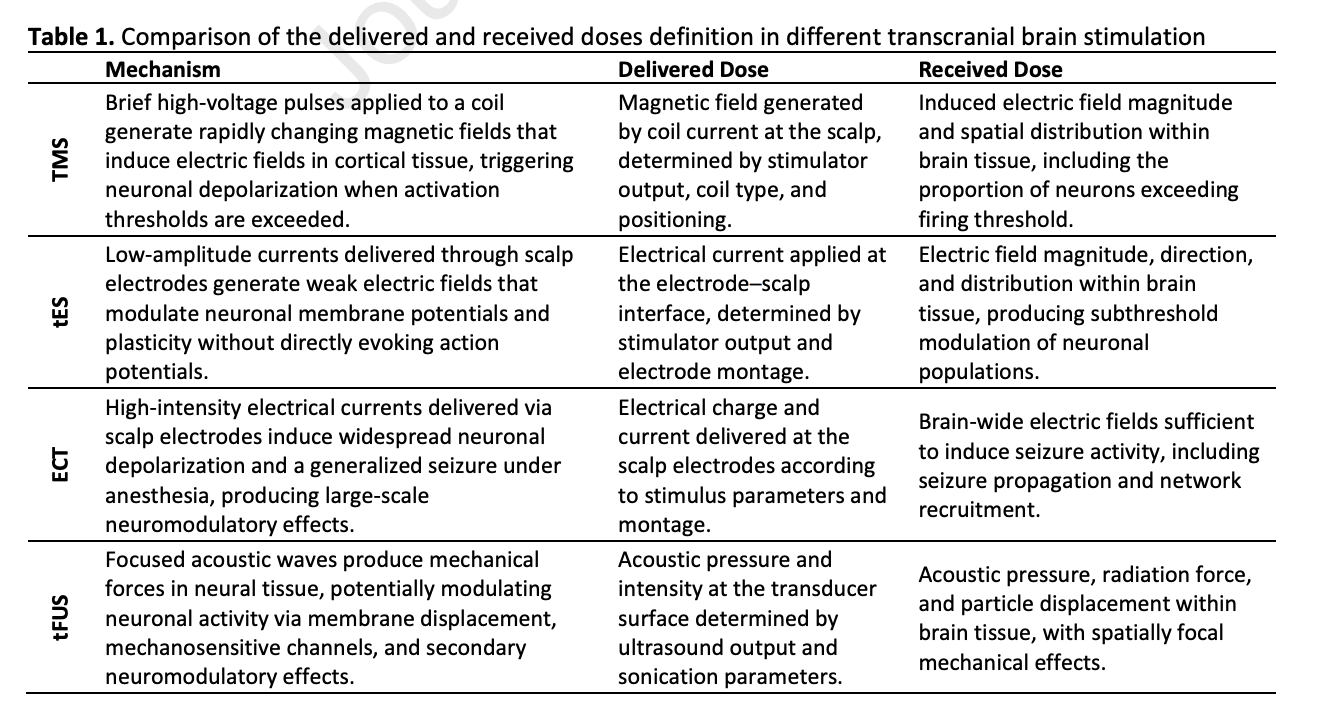
Abstract: The use of noninvasive transcranial brain stimulation methods, such as transcranial electrical stimulation (tES), transcranial magnetic stimulation (TMS), transcranial focused ultrasound stimulation (tFUS), and electroconvulsive therapy (ECT), has grown significantly over the past two decades. Evidence indicates that the dose-response relationship in brain stimulation is neither straightforward nor monotonic, with outcomes influenced by factors such as the brain state, anatomical variability, and neurophysiological mechanisms. Despite advancements in the field, there is still no consensus on standards for estimating and reporting delivered and received stimulation doses or defining dose-response relationships. This paper addresses these gaps by discussing four key areas: (1) factors influencing the delivered dose (stimulation parameters applied at the scalp), (2) quantification of the received dose (electric or acoustic fields delivered to brain tissue), (3) characterization of physiological, behavioral, and molecular responses to specific delivered/received doses, and (4) the dose-response relationship, which describes how variations in dose modulate brain function and behavior. Drawing on evidence from human and animal studies conducted in silico, in vitro, and in vivo, we outline challenges, propose solutions, and summarize current consensus standards. By promoting rigorous methodologies and transparent reporting, this paper aims to advance the reproducibility, safety, and efficacy of research on dose-response assessment in transcranial brain stimulation and its clinical applications.