new paper: Electric bandage for Wound Healing
Koochesfahani MB, Donnery K, Kumar AS, Bhuiyan R, Drumm DA, Mirza B, Perez MP, Uraga MRD, Ponasso GN, Makaroff SN, FallahRad M, Bikson M. Self-powered electronics-free Wearable Disposable Electrotherapy (WDE) platform for accelerated wound healing. Adv Sci 2026 doi: 10.1002/advs.78814. PMID: 42539150 PDF
ABSTRACT
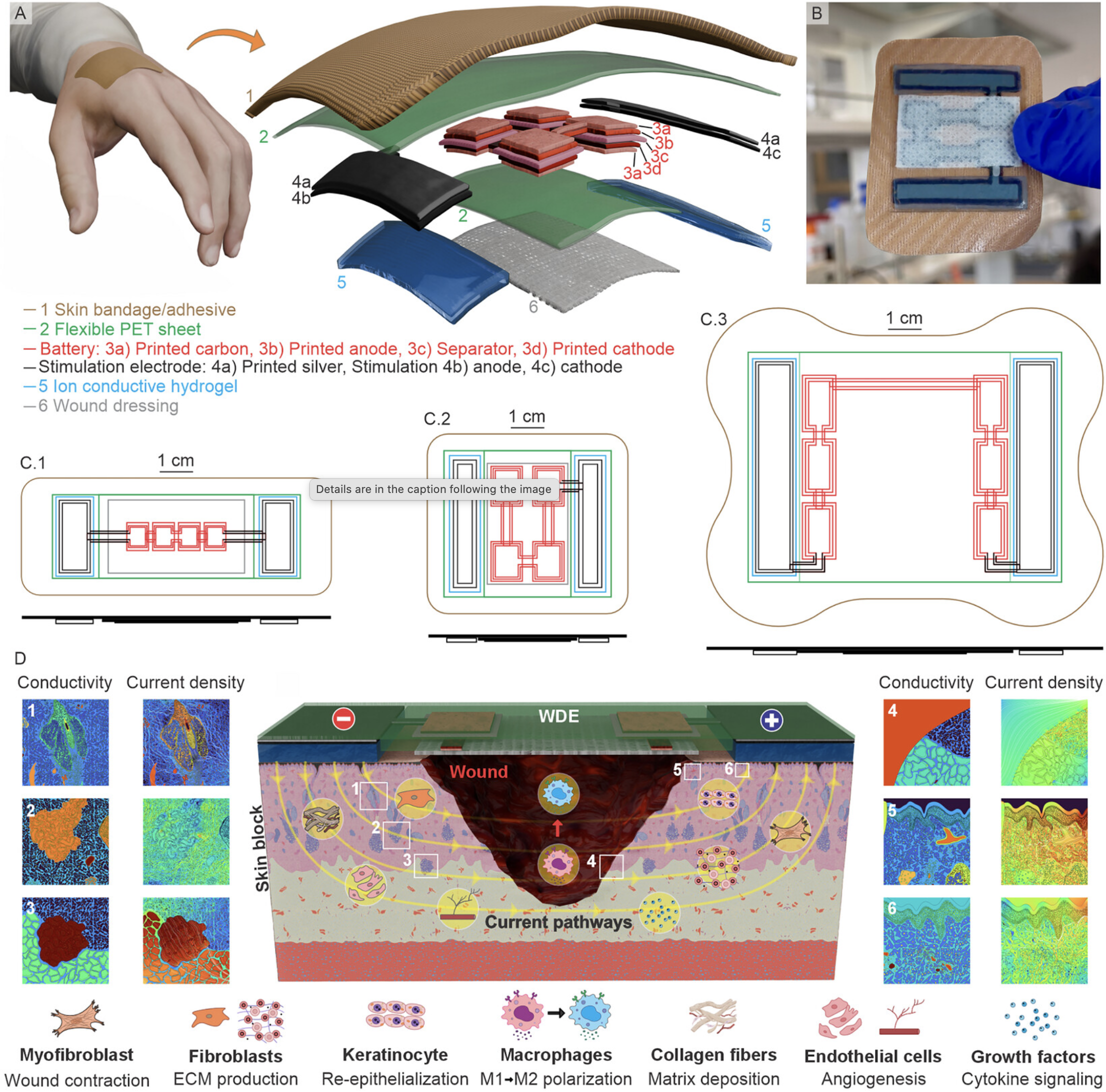
Electrical stimulation accelerates wound repair by modulating endogenous bioelectric signals that regulate inflammation, angiogenesis, extracellular matrix remodeling, and cellular responses within the wound microenvironment. However, clinical translation has been hindered by cumbersome devices that disrupt standard wound-care workflows, direct electrode contact with the wound bed, and/or limited stimulation output. Wearable Disposable Electrotherapy (WDE) integrates an electronics-free printed electrochemical architecture into an mm-thick patch that looks and is applied like a conventional bandage. The device is self-powered and delivers a single electrotherapy dose simply by application to the skin. Efficacy was evaluated in a full-thickness excisional wound model in rats against sham and conventional Constant Current (CC) stimulation. WDE reduced the time required to achieve 50% wound closure by 2.08 days (∼29%) relative to sham. Histological and immunofluorescence analyses at day 14 demonstrated increased collagen deposition (∼25%), tissue cellularity (∼73%), αSMA (∼2.6-fold), CD31 (∼2.0-fold), CD206 (∼2.0-fold), and iNOS (∼1.7-fold) expression compared with sham. A cellular-resolution dosimetry model using BEM-FMM provides a biophysical framework linking electrical stimulation with the wound microenvironment and tissue repair mechanisms. Together, these findings establish WDE as a practical bioelectric wound dressing with the simplicity and scalability of disposable bandages.